REVIEW · FRANZ JOSEF AND FOX GLACIER
Tandem Skydive 13,000ft from Franz Josef
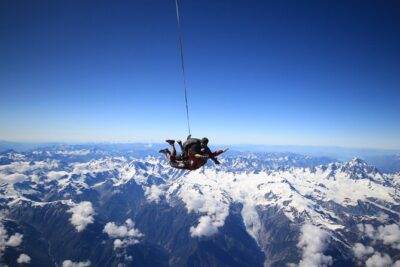
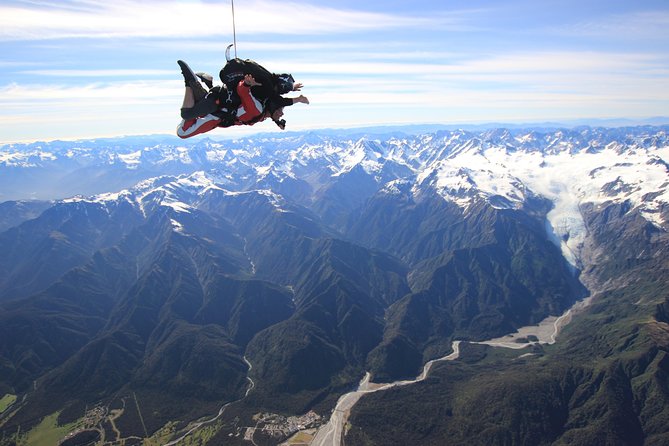
From 13,000 feet, you get far more than a quick thrill. You see Franz Josef Glacier, snowy peaks, braided river beds, rainforest, and the Tasman Sea spread below you before the parachute carries you gently back toward earth. The freefall reaches about 200 kilometers per hour, or 120 miles per hour.
I like the simple setup: you meet at 63 Cron Street in Franz Josef Village, and shared transport takes you to the airport. I also like that no previous jump experience is needed, and that an instructor manages the technical work while you concentrate on the view and the strange joy of stepping out of a plane.
The main drawback is weather. This is a weather-dependent activity in a place known for changing conditions, so you need room in your New Zealand schedule for a delay. If poor weather cancels the jump, you can choose another date or receive a full refund.
Key points to know before you book
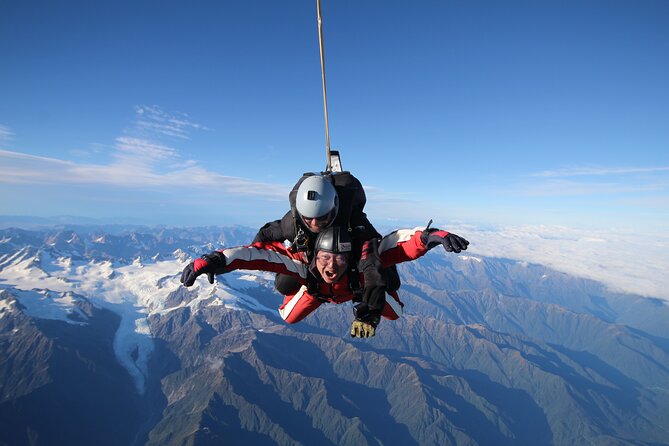
- The 13,000-foot jump gives you a long view: You can see from high mountain country down toward sea level, with glaciers, rivers, forest, and coast in the same outing.
- The freefall is fast: Expect about 200 kph before the parachute opens and the pace settles into a slower float.
- No experience is required: Your tandem instructor controls the equipment and guides you through the jump.
- The base is easy to find: Start at 63 Cron Street in Franz Josef Village, then return there at the end.
- Photos and video cost extra: You can decide after the jump if you want to buy the recorded memories.
- Weather can change the plan: Keep at least part of your day flexible, and avoid booking this immediately before an important connection.
Why Franz Josef is such a striking place to jump
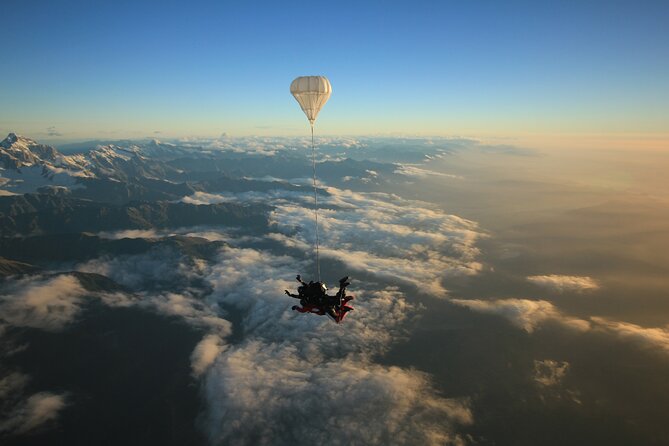
Franz Josef gives this activity an unusually broad setting. You are not looking at one isolated point of interest. From the air, the view can run from the high mountains and ice fields down across rainforest, lakes, river beds, and the coast.
That range matters because the scenery changes as you climb and descend. The glacier is the obvious star, but the braided rivers and dark forest add texture below. On a clear day, the contrast between white ice, rocky peaks, green forest, and the sea gives the jump a sense of scale that you cannot get from ground level.
This is also a useful choice if you want a major West Coast experience without spending a full day on an expedition. The advertised duration is about three hours, including the transfer from the booking office to the airport and the return to the village. It fits more easily into a Franz Josef stay than a long guided outing, though you should not treat the three-hour estimate as a guaranteed appointment with no delays.
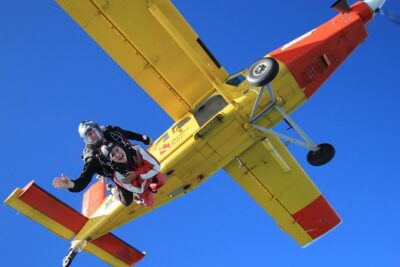
The jump itself is the heart of the activity, but the plane ride up is part of the value. One of the strongest parts of the available feedback describes both the flight and the jump as scenic and enjoyable. That is worth noting if you are nervous about the freefall. The aircraft ascent gives you time to watch the view expand before the more intense part begins.
More High-Altitude Skydives in New Zealand
- 15,000ft Tandem Skydive in Tauranga – Bay of Plenty
★ 5.0 · 305 reviews - 15,000ft Tandem Skydive in Bay of Plenty
★ 5.0 · 180 reviews - Auckland: 13000, 16000, or 18000-Foot Tandem Skydive
★ 4.9 · 151 reviews
From Cron Street to the airport
You begin at 63 Cron Street, Franz Josef / Waiau 7886. The meeting point is in Franz Josef Village, which keeps the first step straightforward. Shared transport to the airport is included, except under COVID-related restrictions.
Once you arrive at the airport, the team provides the skydive equipment, helmet, gloves, goggles, and jumpsuit. You should wear warm, lightweight clothing underneath and secure shoes, preferably with laces. That advice is practical rather than decorative. You will be outdoors in a cool alpine region, and loose clothing or poorly secured footwear is a bad match for the preparation and jump.
The activity requires a moderate level of physical fitness. That does not mean you need special training, but you should be comfortable taking part in an active outdoor experience and following instructions. If you have concerns about your fitness, ask the operator before booking rather than waiting until the day.
The group limit is listed as 70 people. That is a sizeable maximum, so the exact feel of the day can vary. You might be part of a larger group waiting for turns, rather than moving straight from arrival to aircraft. The three-hour estimate gives you a useful planning guide, but I would leave extra breathing room around meals, glacier walks, buses, and other fixed plans.
What the 13,000-foot jump feels like
Tandem jumping removes the hardest decision for a first-timer. You do not need to learn how to operate the parachute or manage the jump alone. You are attached to an instructor, who handles the equipment and directs the process.
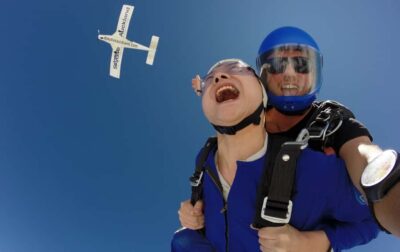
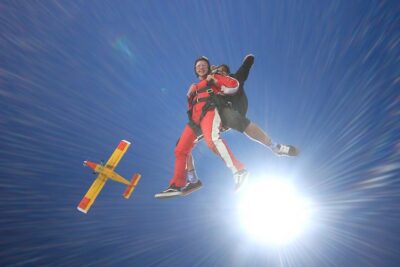
The freefall lasts long enough to feel like the main event, not just a quick drop from the aircraft. At roughly 200 kph, the air is loud and the sensation is intense. You may spend the first moments thinking about the speed, but the wide view soon competes for your attention.
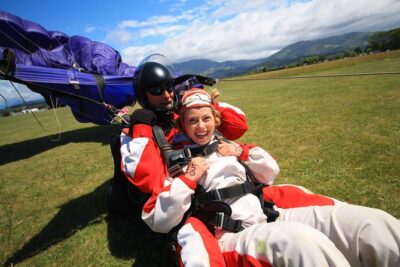
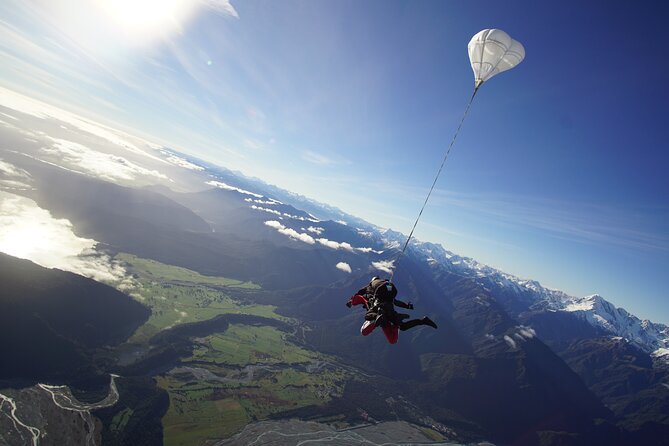
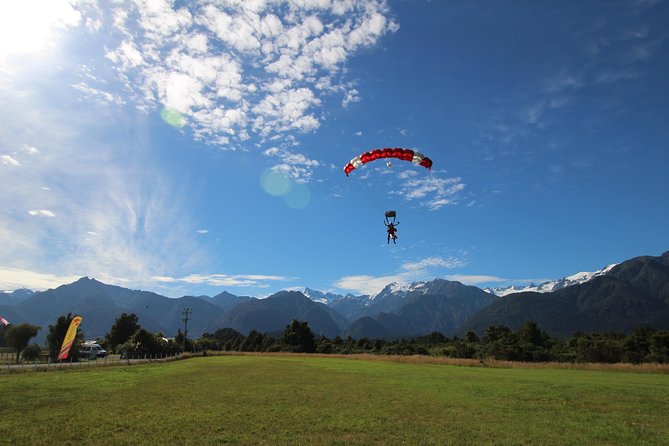
After freefall, the parachute opens and the experience changes character. Instead of the hard rush, you float above the West Coast scenery. This is when you can take in the glacier, peaks, river beds, forest, and coast with more time to look around.
The tandem format is a good fit if you want the thrill without taking a course. You can focus on listening to the instructor, keeping your attention on the moment, and enjoying the scenery. The strongest feedback about the staff points to a useful balance between professionalism and light humor. Danny is specifically praised for giving a nervous participant courage, which tells you something important about the human side of the activity: the instructor is not just attached to your harness, but also helps you cross the mental gap before the jump.
The view from mountain tops to the sea
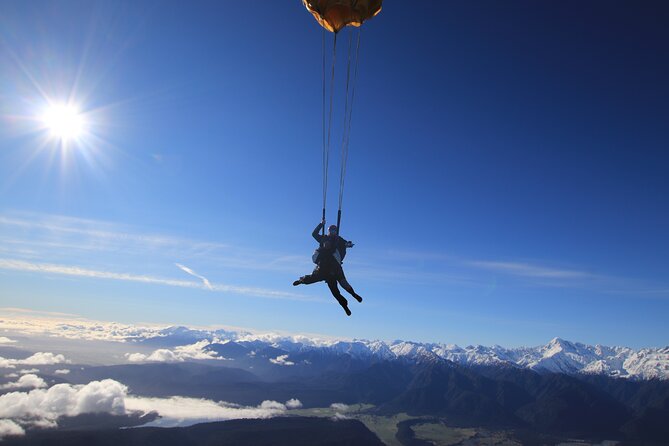
The phrase from mountaintops to sea level is not just sales language here. The setting gives you a genuine vertical sweep. Franz Josef sits between the Southern Alps and the Tasman Sea, so the aerial view can connect high snow country with the lower coastal plain.
The glacier is the feature most people will anticipate, but do not fix your attention on one white patch. Look for the patterns in the river beds, the thick blocks of forest, and the way the ice fields sit beneath the peaks. From above, the region makes more sense as one large system of mountain, water, ice, and coast.
Clear weather is crucial. Cloud can hide the peaks or reduce the view during the ascent and parachute flight. A jump may still go ahead in conditions that feel less than perfect from the ground, but the best reason to book this particular location is the scenery. If the forecast is poor, it may be sensible to postpone rather than rush to use a narrow opening.
The operator requires favorable weather and may cancel when conditions are unsuitable. You will then be offered an alternative date or a full refund. That policy protects safety, but it also means you should avoid scheduling the jump on your final possible hour in Franz Josef.
More Tandem Skydives in New Zealand
- Queenstown: Tandem Skydive Experience
★ 4.8 · 475 reviews - Lake Taupo 12,000-Foot Tandem Skydiving
★ 5.0 · 359 reviews - Tandem Skydive Experience in Taupo
★ 5.0 · 324 reviews - Wanaka: Tandem Skydive Experience
★ 4.8 · 252 reviews
Staff, safety, and the value of tandem jumping
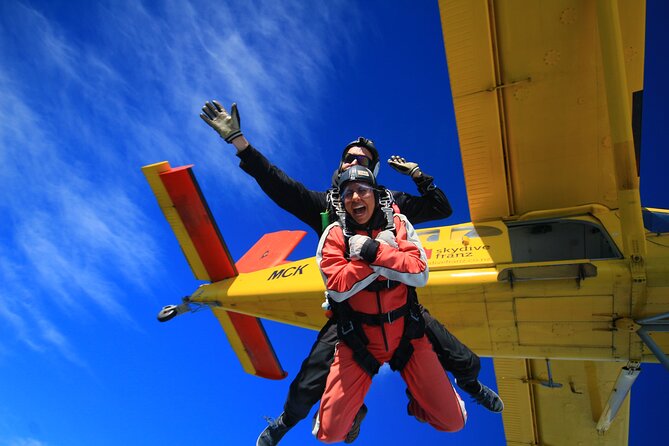
The available rating is 4.7 out of 5 from 16 ratings, with 94 percent recommending the activity. Those numbers suggest a strong record, but they do not remove the need to understand what you are buying. This is an adrenaline activity, not a casual sightseeing flight.
The positive comments focus on the staff’s ability to keep the mood calm while still making the day fun. That balance matters. An instructor who is too casual could make a nervous person uneasy, while a stiff presentation could make the whole event feel colder than it needs to be.
You are supplied with the required jump equipment and protective items. The tandem format puts the technical responsibilities with the instructor, which is why it suits a first jump. You still need to follow instructions and meet the stated physical requirements.
The activity also has a minimum number of participants. If that minimum is not reached and the operator cancels, you receive the choice of another date, another experience, or a full refund. That is worth knowing if you are building a tightly timed itinerary.
Is $276.60 a fair price?
At $276.60 per person, this is a serious holiday expense. You are paying for the aircraft, specialist equipment, instructor, ground arrangements, and a high-altitude jump in one of New Zealand’s most dramatic regions. The shared transfer and supplied gear reduce the number of extra costs you need to arrange yourself.
The price makes the most sense if you want one major adventure rather than several smaller paid activities. The experience combines the flight, freefall, parachute ride, and aerial view. It is not simply a short jump followed by a quick return to town.
Photos and video are not included. You can purchase them afterward, and one detailed account says the package included three different videos and more than 300 photos delivered within hours. That is a substantial record of the day, but it can also push the final cost well above the advertised price.
I would decide your photo budget before arrival. If you want proof of the jump, the extra package may be worth considering. If you mainly want the memory and the scenery, you can skip the add-on and keep the base price as your limit.
T-shirts and hoodies are also available for purchase, but they are optional. They add no value to the jump itself, so treat them as souvenirs rather than part of the package.
Weather, timing, and the risk of a wasted day
The biggest practical issue is not the freefall. It is the possibility of waiting, postponement, or cancellation.
One cancellation was caused by bad weather after an international journey had been planned around the jump. The staff provided regular updates while the group waited, which is useful service, but good communication cannot produce clear skies. If this jump is your main reason for visiting Franz Josef, plan a backup day if you can.
You may cancel free of charge up to 24 hours before the local start time. Within 24 hours, the amount paid is not refunded, and changes are not accepted. The weather exception is different: if the operator cancels because conditions are poor, you receive an alternative date or a full refund.
For that reason, I would book early enough in your stay to leave room for a second attempt. Do not place it just before a flight, long-distance bus, or fixed ferry booking. The activity is advertised as about three hours, but weather checks and operational timing can affect the day.
Who will enjoy this most?
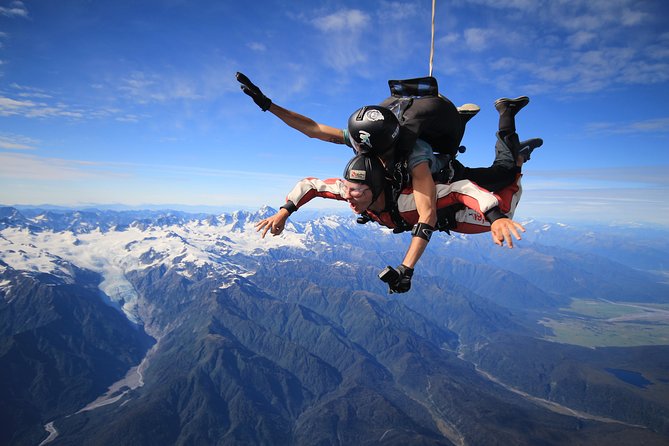
This is best for a first-time jumper who wants a major thrill but does not want to learn the full sport. The tandem setup keeps the technical side with the instructor, while you get the freefall and the scenery.
It also suits photographers and scenery lovers, provided you understand that the optional photo and video package costs extra. The setting is the main reason to choose this jump over a more ordinary skydive.
You should think twice if your schedule is rigid, your budget has no room for add-ons, or you would be deeply disappointed by a weather delay. The operator cannot control the West Coast forecast, and the scenery is a central part of the price.
Should you book the Franz Josef tandem jump?
I would book it if you have at least some flexibility in Franz Josef and want one unforgettable high-energy activity. The combination of 13,000 feet, a 200 kph freefall, glacier views, and a parachute ride above the West Coast gives the jump real value beyond the simple act of leaving a plane.
Book with a weather backup in mind. Wear warm, light layers and laced shoes. Decide in advance if you want photos and video. If you can handle those practical points, this is a strong choice for a first tandem jump in New Zealand.
FAQ
Do I need previous skydiving experience?
No. The activity is designed for people with no previous experience, and you jump with a tandem instructor.
How high is the jump?
The jump is from 13,000 feet.
How fast is the freefall?
The freefall reaches about 200 kilometers per hour, or 120 miles per hour.
How long does the activity take?
The full activity takes approximately three hours.
Where do I meet the group?
You meet at 63 Cron Street, Franz Josef / Waiau 7886, New Zealand.
Does the activity include transport?
Round-trip shared transport from the booking office to the airport is included, except under COVID-related restrictions.
What equipment is provided?
The operator provides skydive equipment, a helmet, gloves, goggles, and a jumpsuit.
What should I wear?
Wear warm, lightweight clothing and secure shoes, preferably shoes with laces.
Are photos and video included?
No. Photo and video packages are available to purchase separately after the jump.
What happens if bad weather cancels the jump?
You can choose an alternative date or receive a full refund if the operator cancels because of poor weather.
Newest jumps around New Zealand
- 13,000ft Skydive over Abel Tasman with NZ’s Most Epic Scenery★ 5.0 · 20 reviews
- 10,000ft Skydive over Abel Tasman with NZ’s Most Epic Scenery★ 5.0 · 10 reviews
- Queenstown: Ticket for 2 Indoor Skydiving Flights★ 4.4 · 15 reviews
- Tandem Skydive 10,000ft from Franz Josef★ 5.0 · 4 reviews
- Tandem Skydive 16,500ft from Franz Josef★ 5.0 · 19 reviews
- 16,500ft Skydive over Abel Tasman with NZ’s Most Epic Scenery★ 5.0 · 23 reviews
- From Motueka: Abel Tasman Tandem Skydive Experience★ 4.9 · 37 reviews
- Tandem Skydive 18,000ft from Franz Josef★ 4.5 · 29 reviews
Tandem Skydives in New Zealand, side by side.
15,000ft Tandem Skydive in Tauranga – Bay of Plenty
Read our review →